

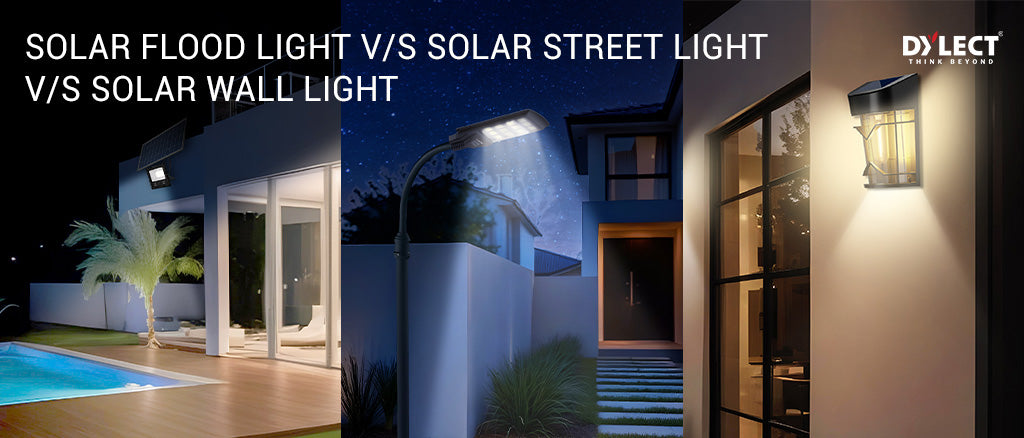
When you’re buying outdoor solar lighting, the biggest mistake is choosing “watts” alone. A solar flood light, solar street light, and solar wall light are built for different jobs—and if you mix them up, you’ll either get weak lighting where you need brightness or end up overspending for a small area.
Here’s the simplest way to think about it:
- Flood lights = wide, powerful spread for areas
- Street lights = higher mounting + broader coverage for roads/driveways/lanes
-
Wall lights = localized illumination for doorways, boundaries, short paths
Below is a practical decision guide (with easy placement tips) so you can buy the right type the first time.
1) Solar Flood Lights: best for wide “area lighting” (parking, terrace, backyard)
What they’re designed to do
A solar flood light is meant to throw a broad beam across a space—like a parking spot, terrace, shopfront, backyard, or a compound corner. They’re ideal when your goal is visibility across an area, not just “a light near a wall.”
When you actually need a flood light
Choose a flood light if you want:
- Bright lighting for parking areas / car porch
- Backyard/terrace illumination for daily use
- Lighting for shops, signage, warehouse entry
- A security-style light for corners and blind spots
Dylect options to consider (by use-case)
- For strong, wide illumination in bigger spaces: Dylect Luxe 150W Solar Flood Light (great when you want a more “powerful flood” effect for open areas).
- For compact outdoor areas + emergency-style utility: Dylect Luxe 60W Solar Flood Light (handy when you want bright light plus additional modes).
- For long runtime + practical daily use: Dylect Eco Solar Flood Light 60W (a strong choice for terraces, courtyards, and shop fronts).
Placement tips (so flood lights don’t disappoint)
- Mount higher than eye level (typically 8–12 ft) aimed slightly downward.
- Keep the solar panel in a sunny, unshaded spot.
- Don’t aim directly at reflective surfaces (glare reduces useful visibility).
2) Solar Street Lights: best for long coverage (gates, driveways, society lanes)
What they’re designed to do
A solar street light is built to cover a larger footprint from a higher mounting point. Street lights are ideal when you want the “one light covers the lane/driveway” effect—especially for gates, approach roads, farm paths, or society parking lanes.
When you actually need a street light
Choose a street light if you want:
- A main gate + driveway to be lit from one point
- Illumination for private lane, society lane, internal roads
- Light coverage across bigger outdoor spaces without multiple fixtures
- Motion-sensor security light for an outer boundary
Dylect options to consider (by use-case)
- For strong everyday gate/driveway lighting: Dylect Luxe Solar All-In-One Street Light – 300W
- For wider area coverage and higher-output needs: Dylect Luxe Solar All-In-One Street Light – 400W
- For motion-sensor lane/parking security style usage: DYLECT 900W Solar Street Light with Motion Sensor
Placement tips (street lights are all about height)
- Mount 10–16 ft high for best spread (wall/pole mounting).
- Use street lights when you want coverage, not just a bright spot.
- If your lane has trees/buildings, position the panel to avoid shade during peak sun hours.
3) Solar Wall Lights: best for entryways + targeted security (doors, gates, short paths)
What they’re designed to do
A solar wall light is made for close-range lighting. Think: gate pillars, front door, balcony wall, corridor edge, stairs, or a short pathway. They’re not designed to light a full driveway—but they’re perfect when you want presence lighting + motion-trigger security near an entrance.
When you actually need a wall light
Choose a wall light if you want:
- Light right at your main door / balcony / gate pillar
- Motion-sensor lighting for security + convenience
- A simple, low-cost lighting upgrade without wiring
- Accent lighting for daily usability
Dylect options to consider
- For basic motion sensor entry lighting: Dylect Eco Solar Wall Sensor Light
- For wider side-throw illumination (useful at gates/edges): Dylect Eco Solar Wall Sensor Light – Front and Side Illumination (200 Lumen)
- For a stronger wall light with motion + multiple modes: Dylect Luxe Solar Motion Wall Light
Placement tips (avoid false triggers)
- Mount around 6–8 ft high.
- Angle it toward the zone you want detected (entry path, stairs, gate latch area).
- Don’t point it toward moving trees/flags if motion triggers are too frequent.
Quick decision guide (choose in 20 seconds)
Choose a Solar Flood Light if:
- You want bright light for parking/terrace/backyard/shopfront
- You care about wide, powerful spread over a zone
Choose a Solar Street Light if:
- You want lane/driveway/gate approach coverage from one higher point
- You want a “street-style” spread across a longer area
Choose a Solar Wall Light if:
- You need lighting at doors, balconies, gate pillars, short paths
- You want motion sensor convenience near entry points
The 5 specs that matter more than “watts”
No matter which category you buy, these are the specs that actually decide satisfaction:
-
Lumens (brightness): more useful than “W” for comparing visible light output
-
Battery capacity: affects runtime during cloudy days and winter
-
Solar panel size/output: affects charging speed and dusk-to-dawn reliability
-
IP rating: important for monsoon + dust (choose higher for exposed locations)
-
Modes & sensors: motion sensor + timer/light sensor modes improve real-world usefulness
Common buying mistakes (and how to avoid them)
-
Buying a wall light for a driveway: you’ll get a small bright patch, not coverage.
-
Installing panels under shade: even partial shade reduces charging dramatically.
-
Ignoring mounting height: street lights need height; wall lights need correct angle.
-
Never cleaning the panel: dust buildup reduces charging; quick wipe every 1–2 weeks helps.
-
Over-lighting the wrong area: aim lights where people walk/park, not where it looks bright from the street.
Dylect solar collections (easy browsing)
If you want to compare by category quickly:
Dylect Solar Lights Collection
Dylect Solar Flood Lights
Dylect Solar Street Lights
Dylect Solar Wall Lights